Have you ever wondered why some websites come up at the top of Google search results, and others are shown as advertisements? This is usually thanks to two important digital marketing techniques – Key difference between SEO and SEM.
Understanding What Are the Key Differences Between SEO and SEM is essential when learning about digital marketing. Both strategies aim to improve your business’s visibility on search engines, attract potential customers, and drive more traffic to your website. However, they achieve these goals through different approaches.
SEO helps your website boost its organic ranking. SEM increases your website’s visibility through paid search advertising, helping your business reach potential customers more quickly.
Table of Contents
What Is SEO?
SEO stands for Search Engine Optimisation. SEO is the process of optimising your website to improve its visibility in organic (non-paid) search engine results, such as those on Google.
Understanding the key differences between SEO and SEM helps businesses choose the right digital marketing strategy to improve their online visibility.
The aim of SEO is to help your website appear in searches for products, services or information related to your business.
Let’s say you’re a Bakery in Thrissur. When someone searches for ‘best bakery in Thrissur’ on Google you want your website to appear within the top organic results.
By improving your website content, technical aspects, user experience and online authority, you can increase your visibility through SEO.
How Does SEO Work?
SEO focuses on improving your website so that search engines can better understand its content and identify how relevant and valuable it is to users. Generally, there are three key areas of SEO:
On Page SEO
This involves refining and optimising your website’s content and pages to improve their visibility in search engine results.
Key tasks include:
- Optimising content with relevant keywords
- Optimising titles and meta descriptions for SEO
- Optimising headings (h1, h2, h3)
- Optimising your images with alt text
- Creating useful content
- Linking internally
Off Page SEO
Off-page SEO focuses on improving your website’s search engine rankings through activities carried out outside your website.
This can include:
- Earning high quality backlinks
- Guest posting
- Creating brand mentions
- Promoting your content through relevant online communities
- Managing your online reputation
Technical SEO
Technical SEO focuses on improving your website’s technical elements to help search engines efficiently crawl, understand, and index your web pages.
This can include:
- Improving loading speed
- Making your website mobile friendly
- Creating an XML sitemap
- Fixing broken links
- HTTPS security
- Structured data
For example, if you create a blog post called ‘Best Digital Marketing Strategies for Small Businesses’, by doing keyword research, creating useful content and optimising your website with internal links By implementing technical SEO, your article can improve its chances of gaining organic visibility in Google search results.
What Is SEM?

SEM stands for Search Engine Marketing. SEM is a digital marketing strategy that improves your website’s visibility through paid advertising. Unlike SEO, SEM allows businesses to pay for their ads to appear in search results when users search for specific keywords.
Understanding the key differences between SEO and SEM helps businesses identify how organic search optimisation and paid advertising work differently to improve website visibility.
For example, if you search for ‘digital marketing agency in Kerala’, you may see some adverts at the top of Google. These advertisements are typically created and managed through Google Ads.
Businesses use SEM to quickly reach potential customers, promote their product/service, drive leads and increase sales.
How Does SEM Work?
SEM typically involves developing paid search campaigns that target relevant keywords to reach potential customers.
This involves:
- Keyword Research – Identify the search terms and keywords your target audience uses when looking for products, services, or information online.
- `Create a campaign – Create an advert using a tool such as Google Ads.
- Create your adverts – Create relevant headlines and descriptions to encourage users to click.
- Set a Budget – Determine how much you are willing to spend on your paid advertising campaigns.
- Target your audience – Choose relevant locations, devices and audiences.
- Analyse your data – See how many impressions, clicks and conversions you are getting and how much you’re spending on your adverts.
SEM is generally done using a pay per click method. This means advertisers are charged whenever a user clicks on their ad. However, search advertising also offers other bidding strategies to help businesses achieve their marketing goals.
For example, if you’re a digital marketing agency in Kerala looking to gain new clients, you could create a Google Ads campaign using keywords such as ‘digital marketing services in Kerala’ or ‘SEO agency near me’.
Your advert could appear within the search results, helping potential customers find your business.
What Are the Main Differences Between SEO and SEM?
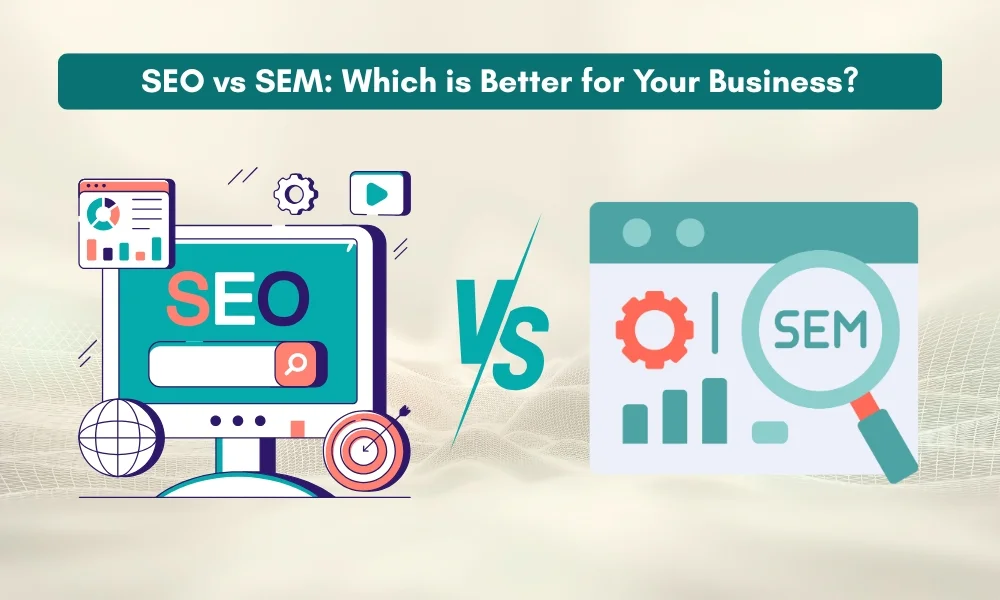
Now we’ve understood what both SEO and SEM are, let’s have a look at the key differences between them.
Although both aim to increase visibility on search engines they differ in cost, results, traffic and long term benefits.
| Factors | SEO | SEM |
| Full Form | Search Engine Optimisation | Search Engine Marketing |
| Type of Marketing | Organic | Paid Search |
| Cost | No cost for organic clicks but will incur costs for optimisation. | Will incur a cost for advertising. |
| Results | Takes time. | Can give immediate visibility. |
| Traffic | Organic traffic. | Paid traffic. |
| Sustainable | Can give long term traffic. | Traffic usually stops when adverts are stopped. |
| Rankings | Based on organic search results. | Based on bidding and other factors. |
| Main Tasks | Optimising content, backlinking, technical SEO. | Paid advertising, bidding, writing adverts. |
| Best For | Long term organic growth. | Immediate visibility and generating leads. |
1. SEO vs SEM – Cost
One of the main differences between SEO and SEM is the cost involved in implementing each strategy.
With SEO, you won’t incur any costs from Google for organic clicks. However, you will incur costs for creating content, optimising your website, using SEO tools and employing professionals.
With SEM, businesses need to allocate a budget for paid advertising campaigns. Depending on your industry and how competitive your keywords are, you may incur higher costs to get more clicks and conversions.
2. SEO vs SEM – Time to Get Results
SEO isa long-term strategy that may take several months to deliver noticeable improvements in search engine rankings and organic traffic.
SEM can give you immediate visibility through paid search.
If you need leads quickly then SEM can be a useful strategy. If you want long term organic visibility then SEO is a key investment.
3. SEO vs SEM – Traffic
SEO can drive traffic throughorganic search.
SEM can drive traffic through paid adverts.
For example, if someone searches for ‘best SEO agency in Kerala’, they may click on an organic blog or paid advert.
Both can drive relevant traffic to your website.
4. SEO vs SEM – Long Term Benefits
SEO can create long term value for your business with useful content, relevant backlinks and a well performing website.
SEM can give you more control over your budgets, audiences and when your adverts run. However, paid traffic will generally drop when your adverts are stopped.
Benefits of SEO and SEM for Businesses
Both SEO and SEM can provide great opportunities for businesses wanting to improve their online presence.
Benefits of SEO:
- Long term organic visibility – Well optimised pages can continue to drive traffic.
- Cost effective – No cost for organic clicks.
- Builds credibility – Being found in relevant organic searches can help build trust.
- Improved user experience – SEO can help improve navigation on your website.
- Helps with content marketing – Useful blogs and landing pages can help attract potential customers.
Benefits of SEM:
- Immediate visibility – Paid adverts can appear in search results quickly.
- Targeted – Can target audiences using keywords, locations etc.
- Controlled budgets – Can set daily budgets.
- Trackable – Can track clicks, conversions and how much you’re spending on adverts.
- Flexible – Can make changes to your adverts, targeting and budgets.
SEO vs SEM – Which is Best for Your Business?
A common question asked by business owners is whether SEO or SEM is best.
This will depend on your business goals, budget, competition and time frame.
If you want to generate leads quickly, launch a new product/service, promote seasonal offers, target specific audiences forIf you want to drive long term organic traffic to your website, improve your website visibility on search engines, regularly produce useful content, build your brand as an authority in your industry and have time to invest in long term organic growth, then SEO is the way to go.
Can I Use Both SEO & SEM?
Absolutely. In fact, using both key differences between SEO and SEM can be a great search marketing strategy.
Let’s say you have an online clothing store.
You can use SEO to create blogs around fashion trends, optimise your product pages and drive organic traffic.
You can also use Google Ads to promote specific products, reaching customers looking for specific items and creating immediate sales opportunities.
Using both will help you reach potential customers at different points in their buyer journey.
How to Create an Effective SEO & SEM Strategy
If you want to improve your website performance in search engines, understanding the key differences between SEO and SEM is important. Both strategies can work together to increase website visibility, attract potential customers and improve online performance.
Follow these steps to create an effective SEO and SEM strategy:
Step 1 – Know Your Target Audience
Know who your customers are, what they need and what they search for.
Understand their pain points, interests and purchase behaviour to choose the right keywords.
Step 2 – Keyword Research
Use tools such as Google Keyword Planner, Google Search Console, Ahrefs or Semrush to find relevant keywords.
For example:
- Primary keyword – Digital marketing agency.
- Secondary keyword – SEO services.
- Long tail keyword – Best digital marketing agency for small businesses in Kerala.
Choose keywords that are relevant to your business and what users are searching for.
Step 3 – Optimise Your Website
Optimise your website content, titles, meta descriptions, headings, images and internal links.
Ensure your website is mobile friendly, secure and easy to navigate.
SEO focuses on improving organic visibility, which is one of the important key differences between SEO and SEM.
Step 4 – Create Relevant Google Ads
Create campaigns around keywords related to your products/services. Write compelling adverts, create relevant landing pages and set realistic budgets.
Step 5 – Analyse & Optimise
Use Google Analytics 4 and Google Search Console to understand how much organic traffic you’re driving and how your website is performing.
For paid adverts, use Google Ads reporting to see how many clicks, conversions and cost per conversion you’re getting.
Regularly analyse your results and optimise your strategy. Understanding the key differences between SEO and SEM helps you measure the performance of both organic and paid marketing campaigns.
Common Questions About SEO & SEM
1. What is the main difference between SEO and SEM?
SEO helps improve your organic search rankings, without paying for individual clicks. SEM helps increase your website visibility through paid search adverts. The main key differences between SEO and SEM are their approach, cost, time and method of attracting website traffic. Both help your business drive relevant search traffic.
2. Is SEO better than SEM?
It really depends on your goals and budget. SEO can be a useful strategy for long term organic growth whilst SEM can be a good option if you want immediate visibility. Choose whichever is best for you.
3. Is SEO free?
Whilst organic search clicks are free, SEO isn’t necessarily free. Businesses may have to pay for SEO professionals, content creation, website development and optimisation tools.
4. Does SEM include SEO?
SEM can mean different things to different people within the industry. However, in modern marketing, SEM is generally referring to paid search adverts. SEO is seen as a separate strategy for organic search. Both are part of search marketing.
5. How long does SEO take to work?
SEO can take time to work. It will depend on how competitive your keywords are, how authoritative your website is, the quality of your content and technical aspects. It can take several months to see any real improvements. There is no guarantee when you’ll start seeing rankings.
6. Can small businesses use both SEO & SEM?
Yes. Small businesses can use both SEO and SEM depending on their resources. SEO can help with long term visibility whilst SEM can help with specific promotions. Understanding the key differences between SEO and SEM helps small businesses decide how to use both strategies effectively.
Conclusion – What Is the Key Differences Between SEO and SEM?
Understanding the key differences between SEO and SEM can help your business make smarter decisions when it comes to digital marketing.
SEO helps improve organic visibility through optimising your content, technical aspects and website authority. SEM helps you reach potential customers through paid adverts.
Both have their own benefits. Whilst SEO can help with long term sustainable growth, SEM can help you gain visibility quickly.
The best option isn’t always one or the other. Using both can help your business improve its online presence, reaching more potential customers and giving you better results.
Ready to improve your online visibility? Start by finding your target keywords, optimising your website and creating a search marketing strategy. Invest in SEO for long term growth and use SEM strategically.